
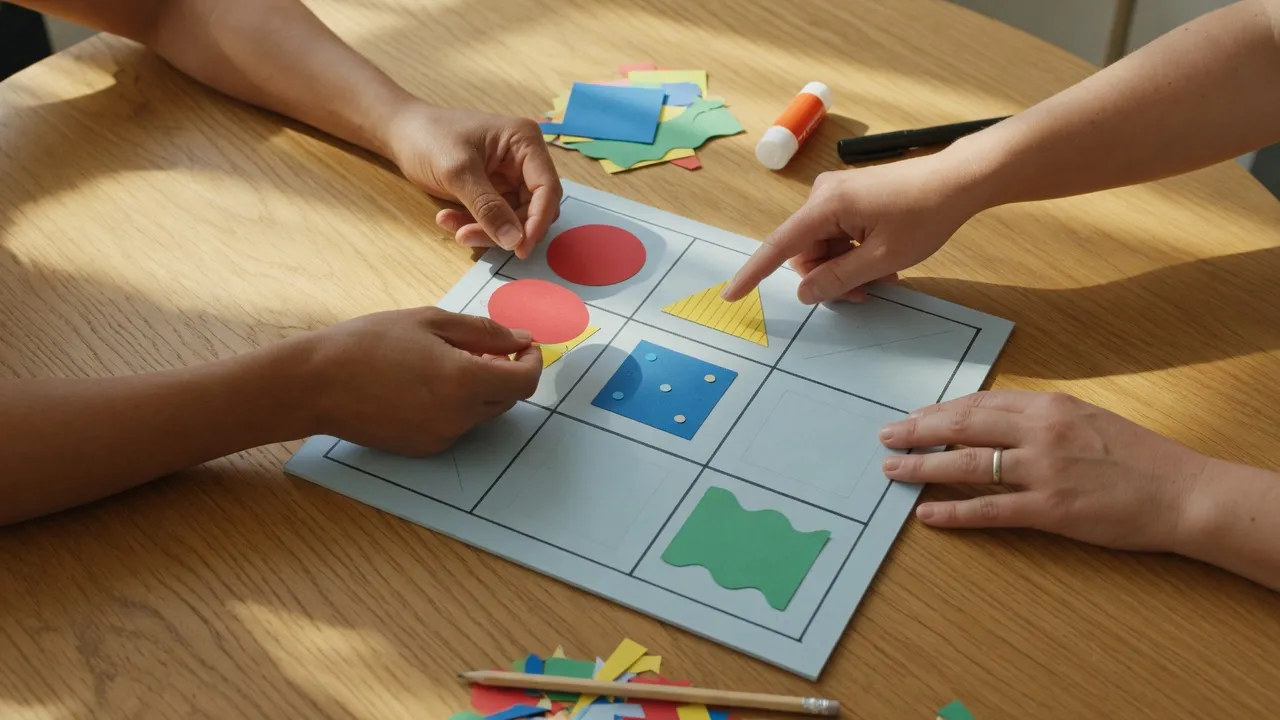
Train your memory can mean almost anything. Worksheets. An app with a streak counter. An hour a week of puzzles somebody bought in a panic. Sudoku, because a neighbour said so.
The trouble is not that any of those are harmful. It is that without knowing what has actually slipped, there is no way to tell whether the hour is aimed at the difficulty or simply next to it.
How you know the hour is missing
You have been doing the exercises for months and the thread still goes in the middle of the shopping. The family keeps saying you have to practise. You are tired of it and you feel examined. And nobody in the house can say whether any of it is working, because nobody agreed at the start what working would look like.
That is the gap. Not effort — direction.
Why the assessment comes first
Cognitive stimulation should start from three things: what is still intact, what has actually gone, and what the person needs to keep being able to do. None of those is knowable from watching someone struggle in a kitchen, which is what makes the guesswork so expensive.
With that information, the work can be chosen and then checked. Without it, you are buying an activity and hoping. What an assessment involves is set out here; the short version is that it is a structured look at how attention, memory, language and planning are actually working, and it is always carried out in person, at home — never by video call.
And it is worth saying plainly what nobody should be promising: this does not restore anyone to the memory they had at fifty, and it does not stop a disease. Anyone offering either is selling something.
What the work looks like when it is aimed at something
There is no single worksheet, and the difference between a targeted exercise and a generic one is easiest to see in examples.
If sustained attention is the weak point, the work might be taking an everyday task, breaking it into ordered steps and timing it — not a sudoku. The difficulty is holding a thread across several minutes, so that is what gets practised.
If it is word retrieval, the work runs on categories, associations and cues: routes back to a word that has not gone, only become harder to reach. A generic crossword does not train that, whatever it feels like.
If it is prospective memory — remembering to do something later, which is the one that actually breaks households — the exercise is the real diary for the coming week. Set the alarm. Check it. Find out where the system fails, adjust it, and keep adjusting until it works on a Tuesday and not only in the session. A system that works in front of the psychologist and nowhere else has not been finished.
The material is already in the house
This is the part families find hardest to believe: you do not need to buy anything, and you do not need to download anything.
A recipe that has been coming out wrong for months. The shopping list. The names of the grandchildren. The bills, the appointments, the route to the pharmacy. What has been slipping in daily life is almost always the best available exercise, because it is the thing that matters and because progress in it is visible to everybody without a score.
There is a version of this worth mentioning if you are the relative abroad. Wanting to help from two thousand miles away is a real feeling and puzzle books are what it reaches for — they are easy to post and they arrive as something. If you want to send something useful instead, send your time: a fixed weekly call at the same hour, where the diary for the week gets talked through, is worth more than any book, and it is one of the few things distance does not spoil.
What language it is worked in
For a family split across two languages this is a practical question, not a detail.
The work should run in the language of the activity being kept. If the shopping, the pharmacy and the neighbours happen in Spanish, practising those in English trains something the person does not need. If the phone calls with the family, the paperwork and the reading happen in English, that is where the work belongs. In most bilingual households the honest answer is both, in different places — and which exercise uses which language is a decision to make case by case, out loud, at the start.
What a plan should contain
Not an open-ended commitment.
What is being worked on this week, stated in a sentence anybody in the house could repeat.
A date when it gets reviewed, agreed in advance. Not we’ll see how it goes.
What happens at that point: carry on, change the approach, or stop because it has gone as far as it usefully can. Stopping should be named as a legitimate outcome on day one, so that nobody experiences it later as a failure.
If what you are being offered has no review point and no exit, ask why.
What the family is asked to do, and not do
Whoever lives with the person can help enormously, and the way they help matters more than the amount.
The single most useful instruction is: do not supervise the exercises. The moment practice becomes something that is marked, it turns into an exam, and being examined all day by people who love you is the fastest route to refusing to do any of it. Consistency is worth more than correction — the same routine, the same wording for the same things, the same level of help for the same task.
Unlike the assessment, this part of the work does not have to happen face to face. Stimulation sessions and follow-up can be done at home in Granada or by video call, and the sessions that are really about coaching whoever does the day-to-day can include a relative dialling in from another country.
When to ask about it
When you are already doing exercises and cannot tell whether they are doing anything. When the memory has started to cost the day rather than just annoy. When you want work that follows from a specific difficulty rather than a pack that arrives the same for everyone.
And if nobody has assessed anything yet, that is where this starts. Telling an ordinary lapse from a pattern is the question that comes before this one.
Talking it through in English
Fernando Ruiz Martínez is a psychologist and neuropsychologist in Granada (Col. M-39091), working in English or Spanish, at home in Granada or by video call for the parts of the work that allow it.
The first conversation is free, by phone or video call, and can be had from abroad. If you already have a report and cannot tell what should be done with it, that is a good thing to bring to it.