HomeNeuropsychologyMemory and cognitive assessment
You want to know what is actually happening with your memory.
For adults. Always in person, at your home in Granada, with the interview and the report in English.
How it works
- The interview. What you have noticed, since when, and what it has changed. If someone lives with you, their account is part of it: they see things you cannot.
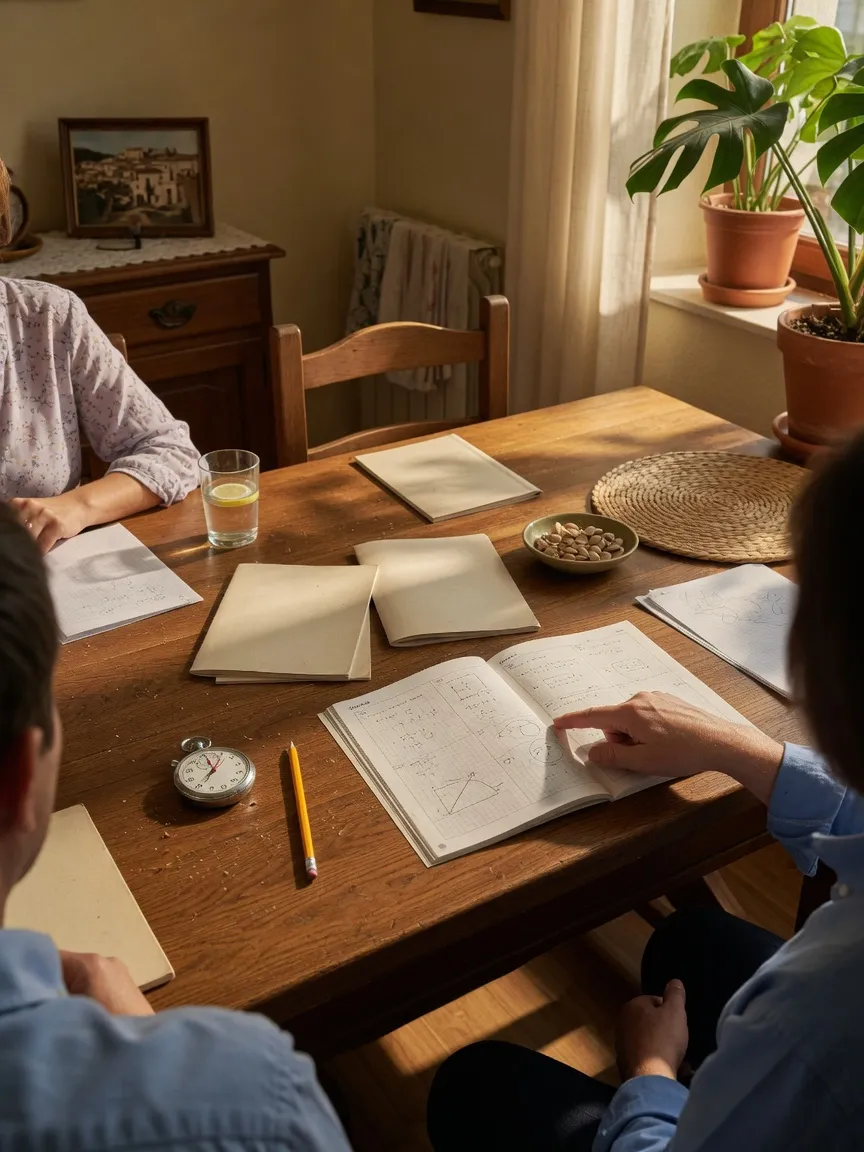
- The tests. Standardised tests, given in person with the physical material they require, chosen for what has to be looked at in your case.
- Scoring and analysis. Your results set against the norms for your age and education, and read alongside sleep, mood, medication and everything else that moves these numbers.
- The report and the feedback session. A written report, plus a conversation where I explain in plain English what it says and what I would do next. Written in English or Spanish, in the standard international format.
Getting this looked at in a country you did not grow up in
If you retired to Spain, or moved here later in life, the machinery you would have used at home is not there. You may not have a doctor who has known you for twenty years, you may not be sure how a referral works, and the appointment where this would be raised would happen in Spanish, at speed, about something that frightens you.
So it gets postponed. Not because the family does not care, but because nobody knows where to start and because saying it out loud makes it real. Meanwhile the not knowing does its own damage, to the person and to whoever lives with them.
An assessment does not decide anything on its own. What it gives you is a measurement: a description of how memory, attention and thinking are working right now, in figures a doctor anywhere can read, and a written record to compare against later.
What you get out of it
Not a verdict. A clear picture, in your own language, and something you can act on.
- You know which parts of thinking are affected and which are intact, and it is rarely all one thing.
- You have a written report, in English or Spanish, that a doctor here or in your home country can read and use.
- The family stops guessing, and the argument about whether this is 'really' happening has something factual underneath it.
- If nothing is wrong, you have that in writing too, and a baseline to compare against if anything changes later.
Who it is for
If you are worried about your own memory, or about a parent's, and you want a proper picture rather than reassurance — in English, and without having to argue your way through a system you do not know.
- What is actually being measured: memory, attention, language and executive function, and how each one is holding up.
- Whether what you are seeing fits ordinary ageing, the effect of stress, sleep or mood, or something that needs following up.
- A written report you can take to a doctor here or in your own country.
Who it is not for
It is not a diagnosis of dementia handed over on the day, and it is not a screening questionnaire. It cannot be done by video call, and I will not pretend otherwise to make it easier to arrange.
When it makes sense to get in touch. When the forgetting has started to change what you do; when the family has begun quietly covering for it; when a doctor has raised it; or when you want a baseline now, so that any later change has something to be compared against.
The first consultation is free. It is there for you to tell me what is going on and for me to see whether I can help, with no obligation to continue.Book the free consultation →
Frequently asked questions
Where does the memory and cognitive assessment take place?
Always in person, at your home in Granada. The tests need physical material and direct observation, so this part is never done by video call.
Can it be done by video call if travelling is difficult?
No. It is always in person: I come to your home in Granada. The tests need physical material, timing and direct observation of how you go about them, and giving them remotely would invalidate the results.
Will the report be accepted by a doctor in the UK or another country?
The report describes the tests used and the results in the standard international format, so a professional elsewhere can read it and carry on from there. I cannot guarantee how a particular institution will treat a document from abroad, but the content itself is not tied to Spain.
My father does not want to be tested. What do I do?
That is common, and it is worth taking seriously rather than working around. Bring it to the free first consultation: the resistance is usually about what a result would mean rather than about the tests, and how it is proposed makes a large difference.
Is this the same as the memory test at the doctor's?
No. A short screening at a surgery takes a few minutes and tells you whether to look further. This looks at each cognitive area in depth, compares your results with the norms for your age and education, and produces a written report.
Can the whole thing be done in English?
Yes: the interview, the feedback session and the report. Where a test depends on language, that affects how it is chosen and how the result is read, and I will tell you where that applies in your case rather than handing you a figure that does not mean what it appears to mean.
What is the first consultation like?
The first consultation —the initial conversation, not the assessment— is free and we do it by phone or by video call. It is there for us to meet, put some order on what is going on and see whether an assessment is what you need. You do not need to arrive with an answer.