
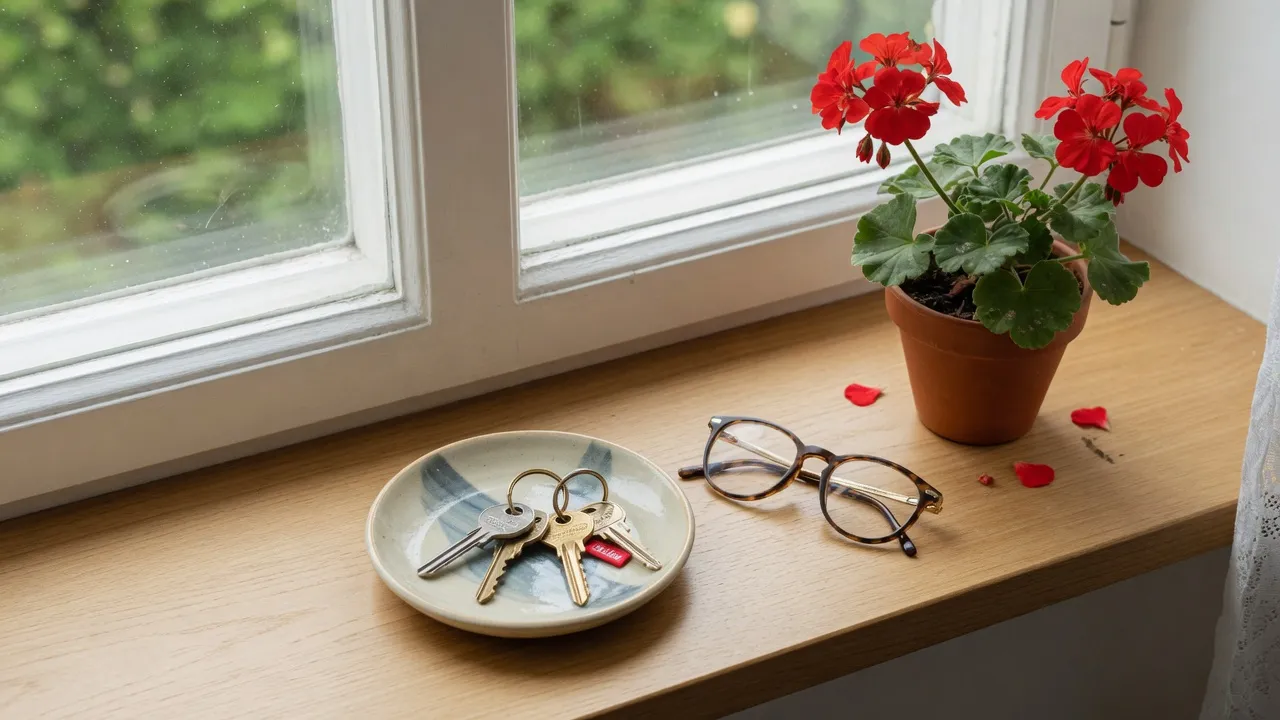
Everyone forgets things. Keys, a name, walking into a room and losing the reason you went in. That happens to almost everybody, and it happens more when sleep is short or the week has been heavy. A lapse on its own is not the thing to worry about.
What is worth paying attention to is a change. This wasn’t like this a year ago. Or the fact that someone who lives with them has been noticing it for longer than you have.
What ordinary forgetting looks like
It corrects itself. The name arrives twenty minutes later in the car. The appointment was written down in the wrong week, not lost. It is scattered across different sorts of tasks rather than concentrated in one, and it doesn’t change what the person can do on their own.
Most importantly, it doesn’t accumulate. Ask again next month and the picture is roughly the same as it was.
What a change looks like
The pattern is different in a few specific ways.
It stays gone. Not “it’ll come to me” but the thing simply isn’t there, and isn’t there later either.
It repeats in the same kind of task. The same question asked three times in an afternoon. The same step of the same recipe. The bills, week after week, not once in a bad month.
It starts costing autonomy. Managing money, dealing with an official form, getting somewhere unfamiliar, keeping track of appointments — things that used to run themselves and now need someone else’s involvement.
More than one person has noticed it separately. The neighbour mentions something, and so does your sister, and neither of them had spoken to the other about it.
None of those, on its own, is a diagnosis of anything. Together, and sustained over months, they are a good enough reason to have it looked at properly rather than argued about at Christmas.
Noticing it from two thousand miles away
If you live in the UK and your parent lives in Granada or down on the coast, you are in an odd position, and it is worth naming.
You see them in steps rather than continuously. Somebody who sits with them every day adapts alongside the change and genuinely may not register it; you arrive in April having last seen them at New Year and the difference lands all at once. That is not you being dramatic. Intermittent contact is often what makes a slope visible.
It also cuts the other way. Phone calls hide a great deal — social conversation is well practised and survives longer than most other things, so a parent can sound entirely themselves for twenty minutes twice a week while the post goes unopened. And a fortnight’s visit is a distorted sample: they are tired, out of routine, and there is a houseful of people.
Two things help. Compare against a specific point in time rather than a vague sense of “before” — what they were managing last summer, not what they were like when you were a teenager. And ask the people who are actually there: whoever cleans, the neighbour, the pharmacist they see every month. They usually have plainer information than anyone in the family.
Memory is not one thing that breaks
This is the part most families are never told, and it changes what you do next.
Remembering depends on a whole system: attention, sleep, mood, hearing, medication, general physical health, and sometimes a neurological process. Any of those can knock the system out, and several of them are treatable.
Poor sleep degrades memory in people of any age. So does depression — low mood in an older person often shows up as forgetting and slowness rather than as sadness, and it is missed constantly. Grief does something similar; if a parent has been widowed, the year that follows is not a fair sample of anyone’s memory. Hearing loss makes people look vague when in fact they never took the information in. And some medications, alone or stacked on top of one another, blunt attention badly.
That list is exactly why the first step is not to search for a disease name at three in the morning. It is to get the thing looked at by someone whose job is to sort out which door the problem is coming through.
What to do before you do anything else
Write down facts for two or three weeks. Not adjectives — examples. What was forgotten, when, what else was going on. Whether sleep has changed. Whether there is a new tablet. Whether the mood dropped first and the forgetting followed, or the other way round. Whoever lives with them can add what they see, as observation rather than evidence for the prosecution.
Get the physical basics checked. Hearing, sight, medication list, and whatever blood tests their doctor thinks are sensible. It is unglamorous and it occasionally explains the whole thing.
Stop testing them. Who came round on Tuesday? What did I just say? Spot checks feel like taking care and land as an exam. They raise the tension, and tension makes memory worse, which makes the next check worse still.
Make the environment do some of the work. One place for the keys. A visible calendar. A pill box. That is not giving up; it is removing friction so you can see what is actually going on underneath.
Don’t start a brain-training regime instead of finding out. Puzzles bought in a panic are not an answer to a question nobody has asked properly yet.
Where an assessment comes in
If the change is real and sustained, the question becomes whether to have a neuropsychological assessment: a structured look at how attention, memory, language and planning are actually working, rather than how they feel on a given day.
It does not put a medical diagnosis on anyone. A doctor does that, with their own investigations. What an assessment gives you is a description — what is holding up, what has slipped, what that means for daily life, and what is worth doing about it. Sometimes what it tells you is precisely that this needs a doctor’s attention, which is useful information to have in writing.
The assessment is always done in person, at home. It is never done by video call: the tasks need physical material, timed conditions and someone watching how they are approached.
When it is worth asking
When the forgetting has held up over months rather than weeks. When somebody who lives with them confirms it. When it has started to change what they can manage alone. When mood or sleep have broken at the same time. Or when the family has reached the point of arguing about whether it is “just age”, which is a conversation nobody wins without better information.
You do not need to be certain before you ask. Not being certain is the reason to ask.
Talking it through in English
Fernando Ruiz Martínez is a psychologist and neuropsychologist in Granada (Col. M-39091), working in English or Spanish — which tends to matter when the family is spread across two countries and the details are hard enough to explain in your own language.
The first conversation is free, by phone or video call, and you are welcome to have it from the UK before anything is arranged. It is a chance to describe what you have noticed and decide whether an assessment is the right next step at all.