
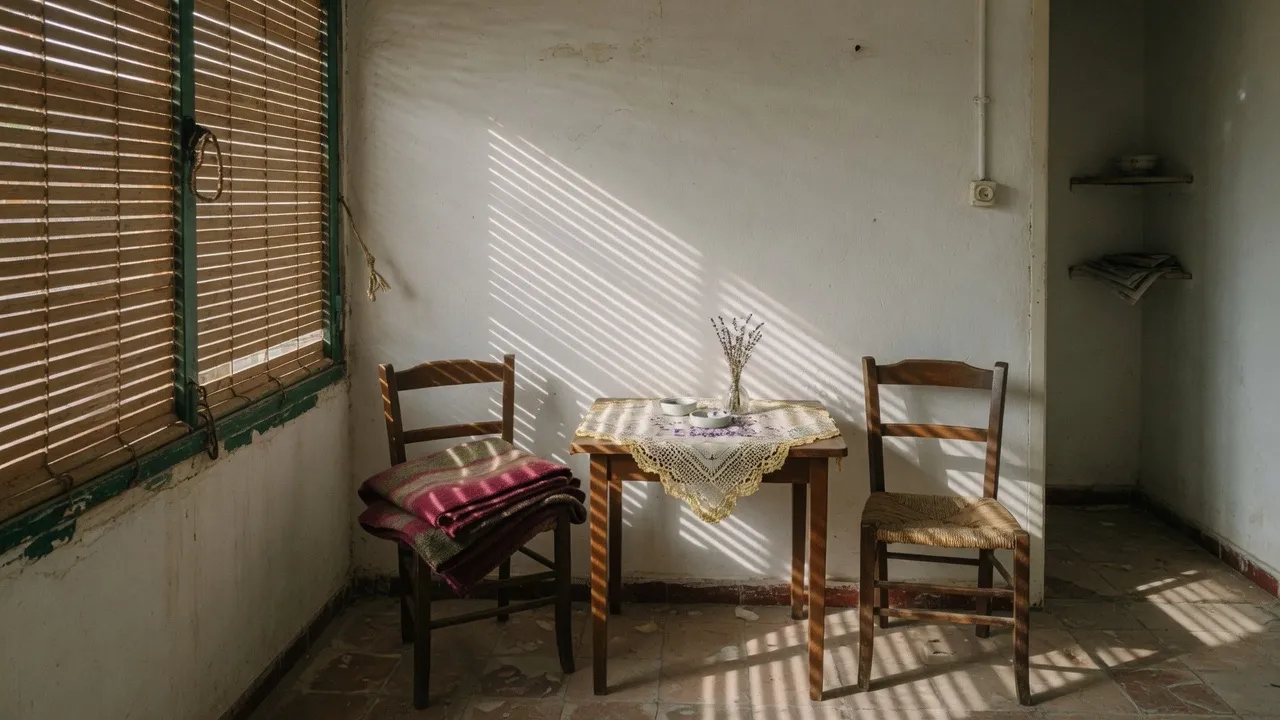
There is a stage before anyone says anything out loud. The house has already started adapting: someone checks the hob on the way past, someone takes over the bank, the same story gets asked about twice and nobody mentions it. Nothing has been decided. The household has simply reorganised itself around a change that hasn’t been named.
That stage can go on for a long time, and it is exhausting in a way that is hard to describe, because everybody is being careful and nobody is talking.
How it looks from the inside
For the person living it: words go missing mid-sentence. A recipe they have made for forty years stops running on its own. Things have to be written down that never had to be written down. And there is irritation, often aimed at whoever is closest, because being corrected all day is humiliating.
A lot of what looks like stubbornness is embarrassment with nowhere to go.
For the family: you start supervising without meaning to. You take a task away “just for now” and it never goes back. You disagree with your brother about whether this is serious or whether everyone is fussing. Nobody is behaving badly. It is the not knowing that takes over the house.
Lapse or pattern
Worth being clear about, because the distinction is what decides whether to do anything.
- A lapse corrects itself — ah, I’ve got it now. A pattern stays gone.
- A lapse is occasional and scattered. A pattern turns up in the same kind of task, week after week.
- A lapse doesn’t change what someone can do alone. A pattern starts to interfere with paperwork, money, appointments, cooking.
- Nobody else notices a lapse. A pattern gets noticed by more than one person, separately, without them having compared notes.
No single item there means anything on its own. All of them, held over months, are reason enough to look at it calmly.
When he says there is nothing wrong
This is the wall most families hit, and it is worth understanding before you push at it.
Sometimes it is pride, or fear of what a diagnosis would mean, or the very reasonable observation that plenty of people his age forget things. But sometimes the person genuinely does not perceive the change. Not denial, not obstinacy — the awareness of one’s own functioning can itself be affected, and then telling someone their memory has changed is telling them something that isn’t true from where they are standing. Arguing harder does not fix that; it just costs you both something.
A few things tend to help.
Drop the evidence file. Listing everything he has got wrong since March will start a fight, and the fight becomes the subject instead of the memory. One recent, concrete, non-humiliating example is more useful than a dossier.
Take the label out of the sentence. We’ll have it looked at; nobody has to decide today what it is. Most refusals are refusals of the word, not of the appointment.
Make it routine rather than exceptional. Tying it to a check-up already happening, or to a doctor’s suggestion, lowers the temperature considerably. If their own doctor raises it, that usually carries further than a son or daughter raising it.
Send the person he can hear it from. In most families that is not the one who has been arguing with him. It might be the other sibling, or an old friend, or a grandchild.
And accept that it is his decision. An assessment nobody has agreed to is not much use anyway — it needs cooperation to mean anything. If the answer today is no, what you can still do is watch, write things down, and keep the door open rather than slamming it once.
Arranging it from another country
If you are in the UK and your mother is in Granada, the practical question is what you can and cannot do from where you are.
You can start it. The first conversation is free, by phone or video call, and it can perfectly well be you having it rather than her — describing what you have seen, asking what the process involves, deciding whether it is worth arranging at all. Many families begin exactly there, before anything has been said at home.
The assessment itself is a different matter: it is always done in person, at home in Granada, and never remotely. Somebody has to be sitting across the table from her, with the material, watching how she does the tasks. That part cannot be arranged around your flights, and it cannot be done from the UK.
What can include you is what happens afterwards. The session where the results are explained, and the conversations about what to do next, can be done by video call, so that the person who lives abroad hears it first-hand rather than as a summary from whoever answered the door. That matters more than it sounds: families that get the explanation second-hand tend to end up with two different versions of it.
Worth agreeing in advance who the point of contact is. When four siblings each ring separately with the same question, the useful information gets lost in the repetition.
What to stop doing
The instinct is to protect, and protecting is where families quietly overshoot. Finishing his sentences. Answering questions put to him. Taking over tasks he can still do slowly and badly, because slowly and badly is uncomfortable to watch.
Every one of those is done out of love, and every one of them removes a bit of practice. The rule of thumb that survives contact with real life: help with the step that has genuinely stopped working, not with the whole task.
The opposite mistake is just as common — insisting he manages something that has become genuinely unsafe to prove a point. Neither of those is a judgement call you should have to make on guesswork, which is precisely what an assessment is for.
When it is worth asking
When the forgetting has already changed how the household runs, or the work, or the paperwork. When a doctor has suggested a neuropsychological assessment and nobody has explained what that means. When the family no longer knows whether to supervise or to leave well alone. Or when you are having the same argument every visit.
You don’t have to wait for a crisis. Waiting for one is how most families end up making these decisions in a hospital corridor with no information.
Talking it through in English
Fernando Ruiz Martínez is a psychologist and neuropsychologist in Granada (Col. M-39091). He works in English or Spanish, at home in Granada — there is no clinic to get anyone to, which removes one argument from the list straight away.
The first conversation is free, by phone or video call, and there is no obligation to go further. It is a reasonable place to bring a situation that hasn’t been said out loud yet.